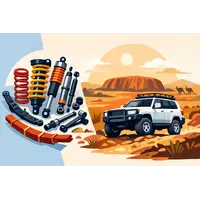
You usually know it’s time to upgrade suspension before you know exactly what to buy. The ute starts sagging with tools in the tray, the wagon feels ordinary with the camper hooked up, or your weekend tracks suddenly remind you how limited factory gear can be. This 4WD suspension buyers guide Australia is built for that exact point - when you need clear answers on lift, load, ride quality and fitment without wasting money on the wrong setup.
The biggest mistake buyers make is shopping by lift height alone. A 2-inch lift sounds simple, but suspension should be matched to how the vehicle is used. If your Hilux is a daily driver that occasionally heads bush, you need a very different setup from a Ranger carrying a constant canopy, drawers and trade gear.
Start with the problem, not the product. If the vehicle sits low in the rear under load, that points to spring rate and load carrying capacity. If it crashes through corrugations or feels unsettled on rough roads, shocks are usually the bigger issue. If you want extra clearance for touring and tougher tracks, then a complete lift kit makes sense, but only if the spring and shock package suits the weight you carry.
That is why there is no one-size-fits-all answer, even within the same model. A D-Max with no accessories needs different coils from a D-Max with a bar, winch and dual battery setup.
A proper suspension upgrade is not just taller springs. Springs support the vehicle’s weight and set ride height. Shocks control how that spring moves. Get one right and the other wrong, and the whole setup feels average.
Coil springs, leaf springs and torsion bars all do the heavy lifting depending on the vehicle. The key factor is load rating. Too soft and the vehicle sags, bottoms out and handles poorly with gear onboard. Too firm and the ride becomes harsh when unladen.
This is where buyers need to be honest. If you only tow a van twice a year, you may not want heavy constant-load rear springs all the time. If your LandCruiser carries touring gear year-round, then soft springs will never feel right for long.
Shocks have a huge effect on comfort, control and confidence on rough roads. Better shocks can settle a floaty vehicle, improve composure over corrugations and help keep tyres working on uneven ground. Different shock designs suit different uses, and price usually reflects heat handling, durability and ride control rather than marketing alone.
For many buyers, this is where trusted brands matter. Dobinsons, Tough Dog, Bilstein and Blackhawk all have strong followings because they offer proven options across work, touring and off-road use. The right choice depends less on badge loyalty and more on vehicle weight, driving style and budget.
Once you lift an IFS vehicle, geometry starts to matter more. On platforms like the Hilux, Ranger, Navara and D-Max, upper control arms may be worth considering when lift height and wheel alignment limits become a factor. They are not always essential, but in the right build they help restore alignment and improve suspension travel.
Airbags are another area where buyers need to think carefully. They can be useful for levelling a load and helping with towing, but they are not a substitute for the correct spring rate. If the rear suspension is wrong to begin with, airbags are only masking the issue.
For most Australian 4WD owners, a modest lift is the sweet spot. Around 40mm to 50mm is common because it improves clearance, approach angles and tyre room without turning the vehicle into a project. It also tends to keep everyday drivability more civilised than going higher.
That said, more lift is not always more usable. Push height too far and you can introduce extra costs, driveline angles, alignment headaches and a stiffer ride if the setup is not engineered properly. If the vehicle spends more time on the road than in ruts, a well-matched moderate lift usually delivers the best result.
The smart buy is the setup that works across your real use. School run, site work, towing, touring and the occasional weekend track all count. If one of those uses dominates, build around that first.
This is where fitment-specific buying saves a lot of pain. Suspension is not just about make and model. Series, year, body style, driveline and accessory weight all affect what suits.
A Pajero used for family touring will want a different feel from a Wrangler built for tougher off-road work. A Navara carrying tools every day needs a different rear spring setup from one that mostly runs empty. A 79 Series LandCruiser with barwork, long-range tank and canopy needs honest weight assessment, not guesswork.
Good suspension buying starts with a shortlist of facts. What vehicle is it? What accessories are fitted now? What weight is constant? What weight is occasional? Is towing part of the job? Once those answers are clear, the product options narrow quickly.
The first mistake is chasing price only. Cheap suspension can cost more when the ride is poor, the load rating is wrong, or the components do not last in Australian conditions. Value matters, but value means buying the right kit once.
The second mistake is over-springing the vehicle. Plenty of buyers assume heavier duty must be better. It is not. If the vehicle is too stiff for its actual load, you lose comfort, traction and control when unladen.
The third is mixing old and new components without a plan. Fresh shocks on tired springs, or a lift added to worn bushes and tired steering components, can leave the whole package feeling unfinished. If the vehicle has serious kilometres on it, it is worth checking the condition of the supporting gear at the same time.
The fourth is ignoring legality and intended tyre size. Lift and tyre changes often go together, but they should be planned together too. Clearance, alignment and compliance all need a bit of thought before parts go on.
If the factory suspension is simply worn out, replacing it with a complete kit often makes the most sense. You get matched springs and shocks designed to work together, and you avoid half-fixing the vehicle.
If your ride height is still acceptable but the vehicle feels loose or unsettled, shocks alone might improve it, although that depends on spring condition and age. For vehicles carrying accessories or towing more often, a full suspension package usually delivers the stronger result because the load support changes with it.
This is especially true on popular platforms like the Hilux, Ranger and LandCruiser where owners often add barwork, drawers, roof racks and towing gear over time. Once the weight creeps up, factory suspension usually shows its limits pretty quickly.
A proper setup should feel more controlled, not just taller. Steering should feel more settled, the vehicle should carry weight with less sag, and rough roads should feel less chaotic. Off-road, you want better clearance and more composure. On-road, you still want predictable manners and decent comfort.
There will always be trade-offs. A suspension package designed for constant load carrying is not going to feel exactly like a soft factory setup when empty. A touring build and a hard off-road build are not identical targets. But if the kit is chosen properly, the trade-off should feel worthwhile every time you drive it.
For Australian buyers, the best result usually comes from shopping by vehicle fitment, intended use and proven brand support, not by generic claims. That is where a specialist retailer with real category depth makes life easier, because the choice is based on your setup rather than a guess from a broad parts catalogue.
If you are replacing tired factory suspension, building a tourer or sorting out a work ute that never sits level anymore, take the extra time to match the springs, shocks and load rating properly. You will feel the difference long before the next trip, and you will be a lot happier with what is under the vehicle when the track gets rough.


Add your favourites to cart


Log into or create your Afterpay account, with instant approval decision

Your purchase will be split into 4 payments, payable every 2 weeks
All you need to apply is to have a debit or credit card, to be over 18 years of age, and to be a resident of country offering Afterpay
Late fees and additional eligibility criteria apply. The first payment may be due at the time of purchase
For complete terms visit afterpay.com/terms