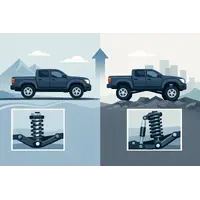
You feel it straight away when factory suspension is past its best. The ute sags with a tray full of gear, the rear kicks over corrugations, and every rut feels harsher than it should. That is usually when people start asking, does a lift kit improve suspension, or does it just make the vehicle sit higher?
The honest answer is that a lift kit can improve suspension, but only when the kit is built around how the vehicle is actually used. Height on its own does not guarantee a better ride, better handling, or better load control. A properly matched suspension upgrade can absolutely transform a 4WD. A cheap or poorly chosen lift can do the opposite.
A lift kit changes more than ride height. On a 4WD, it usually replaces springs and shock absorbers, and in some setups it also brings in parts like upper control arms, leaf packs, torsion bars, airbags or steering correction components. That means the lift itself is only one part of the result.
If you fit quality shocks and springs that are tuned for your vehicle, accessory weight and driving conditions, the suspension can become more controlled, more stable under load and more capable off-road. If you fit a lift purely for looks, with spring rates that are too stiff or shocks that do not suit the vehicle, the ride can become choppy and the handling can suffer.
That is why suspension buyers who get the best result usually start with use case, not just lift height. A Hilux set up for touring with a bar, winch, canopy and drawers needs a different package from a Ranger used as a daily driver with the odd camping trip.
The biggest improvement most drivers notice is control. Fresh shocks do a better job of managing body movement than tired factory dampers, especially once the vehicle has extra weight on it. That can mean less bouncing after bumps, better stability on rough roads and a more planted feel when the tray or cargo area is loaded.
Ground clearance is the obvious gain, and it matters. More clearance under the chassis and better room for larger tyres can help on rutted tracks, rocky sections and uneven terrain. Approach, departure and ramp-over angles can also improve, which makes the vehicle more capable where standard height starts scraping.
Load handling is another major reason people upgrade. Many factory suspension setups are fine when the vehicle is empty, but once you add tools, a towing setup, a canopy, long-range tank or touring gear, they quickly run out of capacity. A lift kit with the right spring rate can help keep the vehicle level and stop it wallowing around under weight.
For plenty of Australian 4WD owners, that is the real value. Not just a tougher stance, but a vehicle that sits properly, carries gear better and feels more composed on country roads and tracks.
This is where the trade-offs matter. Not every lift improves comfort. In fact, some lifts feel firmer than stock, especially if they are chosen with heavy-duty springs on a vehicle that runs around empty most of the time.
That is common with tradies and ute owners who buy for maximum load rating, then spend most weekdays driving with no real weight in the back. The suspension may be better suited to a loaded vehicle, but harsher when unladen. That does not mean the kit is bad. It means the spring rate does not match the day-to-day setup.
Geometry matters too. Once you start lifting independent front suspension vehicles, angles change. Depending on the height and platform, you may need components like upper control arms to restore alignment and droop travel. Ignore that, and the front end can feel nervous, wear tyres unevenly or top out over bumps.
Then there is shock quality. A lift kit with basic dampers may deliver the height you want, but not the ride control you expect. Better shocks are often what separate a suspension upgrade that feels sorted from one that feels cheap.
In many cases, yes, but again, it depends on the build. Off-road improvement comes from a mix of clearance, wheel travel, damping control and load support. Lift height helps with obstacle clearance, but it is not the whole story.
A well-designed kit with quality shocks and springs can keep tyres in contact with the ground more effectively over corrugations and uneven surfaces. That improves traction, comfort and confidence. For touring setups, the benefit often shows up over long distances, where better suspension control reduces driver fatigue and helps the vehicle cope with changing road conditions.
On the other hand, simply raising the vehicle without considering shock valving, spring rate and supporting components can leave you with a taller 4WD that is not actually nicer to drive off-road. It may feel stiffer, less settled or more prone to pitching.
For serious off-road use, suspension should be treated as a system. Lift height is one part. Matching the rest of the components is what turns it into a real upgrade.
The best question is not whether a lift kit improves suspension. It is what kind of lift kit improves suspension for your specific vehicle and setup.
Start with the vehicle platform. A LandCruiser wagon, D-Max, Navara and Wrangler all respond differently to suspension changes. Then look at constant accessory weight. Bull bar, winch, rear bar, drawers, tools, canopy, roof rack and towing setup all affect what springs and shocks will work properly.
Next, be realistic about how the 4WD is used. Daily commuting, tradie work, towing a van, weekend beach work and remote touring all place different demands on the suspension. A kit that is ideal for one driver can be completely wrong for another.
This is also where recognised brands make a difference. Proven kits from names like Dobinsons, Tough Dog, Bilstein and Blackhawk are popular for a reason. They give buyers known quality, platform-specific options and better confidence that the suspension is actually engineered for the job.
A lot of buyers jump straight to a 2-inch lift because it is a common, practical option on many Australian 4WDs. It can provide useful clearance and room for accessories without going too far. But even at that level, the right components still matter.
Two vehicles with the same lift height can drive very differently. One may feel balanced, controlled and capable. The other may feel floaty, harsh or vague. The difference usually comes down to spring selection, shock performance and whether the full package suits the vehicle.
That is why chasing height alone can be a costly shortcut. A properly selected suspension kit should improve function first. If it also gives the stance you want, even better.
It can, especially if your factory suspension is worn or no longer suits the way the vehicle is set up. Many drivers notice better body control, less rear-end sag and more confidence with loads on board. For utes and wagons carrying accessories, the improvement can be significant.
But daily comfort depends on getting the balance right. Too soft, and the vehicle can feel sloppy. Too firm, and every pothole reminds you about it. That is why fitment-specific advice matters, particularly when buying online.
At 4WDSuspension, this is where vehicle-specific kits and clear component matching help take the guesswork out of it. The right package is not just about making the 4WD look better in the driveway. It is about making it work better on the road, on the job and out bush.
If you are choosing between staying stock and upgrading, think less about lift as a fashion item and more about suspension as a working system. When the springs, shocks and supporting parts are matched to your vehicle and load, a lift kit can absolutely improve suspension. When they are not, all you have bought is height with compromises.
The smart move is to buy for how your 4WD actually lives, not just how you want it to look parked up on a Saturday.
Related guide: how to choose 4WD coil spring rates


Add your favourites to cart


Log into or create your Afterpay account, with instant approval decision

Your purchase will be split into 4 payments, payable every 2 weeks
All you need to apply is to have a debit or credit card, to be over 18 years of age, and to be a resident of country offering Afterpay
Late fees and additional eligibility criteria apply. The first payment may be due at the time of purchase
For complete terms visit afterpay.com/terms