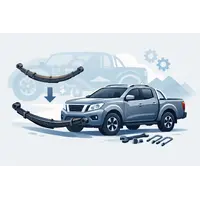
A sagging rear end tells you plenty about a Navara before you even turn the key. If your ute drops under tools, squats with a trailer on, or starts feeling loose and underdone over corrugations, a Nissan Navara leaf spring upgrade is usually the fix that makes the biggest difference quickest.
Factory rear springs are built for broad appeal, not hard Australian use. That works fine when the vehicle is empty and spends most of its life on sealed roads. It works a lot less well when the tray carries trade gear all week, a canopy and drawer setup stay bolted in, or the towball sees regular work on weekends. Once the standard pack starts flattening out (here is how to tell if your leaf springs are sagging), you notice it everywhere - reduced ride height, poorer load control, more bottoming out, and a rear end that feels busier than it should.
The rear leaf pack carries the load, sets ride height, and plays a big role in stability. On a Navara that tows, tours or hauls gear, the standard setup often becomes the weak point long before the rest of the vehicle is ready to retire.
A properly matched spring pack helps keep the rear at the correct working height and gives the shocks a better chance of controlling movement. That means less squat under load, more predictable handling, and better support over rough tracks. It can also improve tyre clearance and help maintain suspension travel when the ute is packed for a trip.
That said, heavier is not automatically better. One of the most common mistakes is fitting a spring rate that suits a permanently loaded work ute to a vehicle that runs empty most of the time. The result can be a harsh, skittish ride and less compliance over small bumps. The best upgrade is the one matched to how your Navara is actually used.
This is where most buyers either get it right and love the result, or get it wrong and chase the fix later with airbags, different shocks, or another spring swap. Spring rate should be based on your constant load, not your biggest once-a-year camping trip.
If your Navara is mostly empty with only occasional towing or weekend gear, a lighter constant load spring usually makes more sense. If you run a steel tray, tools, ladder racks, or a canopy with drawers full-time, a medium or heavy constant load pack is often the better option. For touring rigs with bar work, long-range tanks and rear storage, the extra support can be worth it, but only if the weight is there all the time.
Think about your setup in real numbers. A canopy, drawer system, fridge slide, dual battery and recovery gear add up quickly. So do trade accessories. The rear suspension does not care whether the weight comes from camping gear or tools - it only responds to what is sitting over the axle every day.
Constant load springs are designed around weight that stays in the vehicle full-time. That is the key point. If your rear setup permanently carries 300kg, you want a spring pack that is comfortable and controlled with that 300kg on board.
Occasional load is different. If the ute is empty Monday to Friday and only sees a camper trailer on holiday, going too heavy on the springs may solve one problem and create another. In those cases, some owners combine a sensible leaf spring upgrade with airbags for occasional support. That can work well, but airbags should not be used to mask a spring pack that is already too soft for the base vehicle load.
Many Navara owners look at a leaf spring upgrade because they want lift as well as load support. That is fair enough, but lift should be treated as part of the package, not the only goal.
A modest lift can improve clearance and restore a tired rear end that has sagged below factory height. On a vehicle with worn springs, a new raised pack can feel like a major transformation. But lift numbers on paper only tell part of the story. Accessory weight, canopy fit-out, towball download and spring rate all affect final ride height.
If you are aiming for a balanced setup, the rear should work with the front suspension, not sit sky-high unloaded and then drop back to level as soon as the tray is filled. Good suspension looks right because it is working right.
Leaf springs do not work in isolation. If the rear shocks are tired, under-specced, or not suited to the new spring rate, you will not get the result you paid for. The same goes for worn bushes, shackles and U-bolts.
For most Navara upgrades, it makes sense to treat the rear suspension as a system. A complete package may include new leaf springs, matched shocks, bushes, greasable shackles or pins, and fresh U-bolts. This gives you proper fitment, correct clamping force and a setup designed to work together.
Recognised 4WD suspension brands matter here because consistency matters. With proven names such as Dobinsons, Tough Dog, Bilstein and Blackhawk, you are generally choosing from options with known load ratings, proper vehicle applications and solid support in the Australian market.
A stronger spring resists load, but the shock controls motion. If the rear of the ute still bounces, wallows or kicks sideways on corrugations, the issue is often in the damping. Upgrading leaf springs without matching shocks can leave performance on the table.
For touring and towing, this matters even more. Heat management, control on rough roads and stability with extra mass all depend heavily on shock quality.
A tradie Navara with a steel tray and tools usually needs a different rear setup from a dual-cab touring build with a canopy and camping gear. The same goes for a family ute that only tows a van a few times a year.
For trade use, durability and constant load support are usually the priority. The ute needs to sit right every day, not just when empty in the driveway. A medium to heavy duty leaf pack is often the practical choice.
For touring, comfort still matters, but so does carrying capacity. The best result is often a spring pack rated for the permanent accessories, with shocks chosen to handle long-distance corrugations and rough tracks.
For occasional towing, there is more balance involved. You want enough rear support to keep the vehicle settled with ball weight applied, but not so much spring that the empty ride becomes annoying. This is where fitment advice is worth its weight in gold.
The easiest way to waste money is to shop by lift height alone or choose the heaviest pack because it sounds tougher. Your Navara series, body style, drivetrain, accessory weight and intended use all matter.
Be honest about how the vehicle is used 80 per cent of the time. That is the setup you should buy for. If the ute permanently carries nothing more than a tub liner and recovery kit, say so. If it has a full canopy fit-out and 250kg in the back every day, say that too.
Vehicle-specific fitment is not a small detail. The right parts for a D40 may not be right for an NP300, and even within the same model range there can be important differences depending on year and configuration. Buying from a suspension specialist that knows Navara applications makes the process much easier and reduces the risk of ending up with a pack that does not suit the job.
If your current rear suspension is sagging, bottoming out, or struggling with the load you ask it to carry, yes - usually without much debate. A proper upgrade improves ride height, carrying ability and control in a way you can feel straight away.
Where it gets more nuanced is choosing the exact package. Some owners need a basic replacement pack because the factory springs are worn out. Others want a full rear suspension upgrade to support towing, accessories and off-road use. There is no single best answer for every Navara, only the best match for your build.
That is why the smarter move is to buy for your real load, your real driving, and your real plans for the ute over the next few years - not just what looks good on a spec sheet. If you get that part right, your Navara will sit better, carry weight better and feel more confident every time you put it to work.


Add your favourites to cart


Log into or create your Afterpay account, with instant approval decision

Your purchase will be split into 4 payments, payable every 2 weeks
All you need to apply is to have a debit or credit card, to be over 18 years of age, and to be a resident of country offering Afterpay
Late fees and additional eligibility criteria apply. The first payment may be due at the time of purchase
For complete terms visit afterpay.com/terms