ClickCease Skip to main content

Sale On Now | Up To 30% Off | Shop Sale Online

  • Home
  • Blog
  • About
  • FAQ
  • Contact
4WDSuspension logo
0
  • Call Us Now 1300 120 020
    • Account Home
    • Orders
    • Pay Invoices
    • Reorder
    • Wishlists
    • Resolution Centre
    • Edit My Details
    • Edit My Address Book
  • Shopping Cart 0 Items 0
  • 4WD Lift Kits
    • 2 Inch Lift Kits
  • Control Arm
  • 4WD Shocks
  • Airbags
  • Springs
    • Coil Springs
    • Leaf Springs
    • Torsion bars
  • Steering Damper
  • Suspension Components
  • New
  • Sale
  • Brands
Parts Finder
Parts Finder
Showing Parts For
ViewParts
  • Account
  • 4WD Lift Kits
    • View All 4WD Lift Kits
    • 2 Inch Lift Kits
  • Control Arm
  • 4WD Shocks
  • Airbags
  • Springs
    • View All Springs
    • Coil Springs
    • Leaf Springs
    • Torsion bars
  • Steering Damper
  • Suspension Components
  • New
  • Sale
  • Brands
  • Home
  • Blog
  • About
  • FAQ
  • Contact
  1. Home
  2. Our Blog
  3. How Should Leaf Springs Look? Signs of Sagging or Worn Leaf Springs

How Should Leaf Springs Look? Signs of Sagging or Worn Leaf Springs

  • By: 4WD Suspension
    • Facebook
    • Twitter
    • Pinterest

Leaf springs rarely fail in one dramatic moment. They lose arch slowly, one tank of fuel, one loaded trip and one towing weekend at a time, until the ute that used to sit level now squats at the back before you have even put the tools in. Because the change is gradual, most owners only notice when the headlights start pointing at the treetops or the rear bump stops start taking hits on dirt roads. This guide explains what healthy leaf springs look like, how to check yours at home in ten minutes, what the common symptoms mean, and which fix actually suits your ute.

The short answer: Healthy leaf springs keep a clear upward arch with the vehicle parked unladen, the leaves sit neatly stacked and aligned, the centre bolt, clamps and U-bolts are intact, and the eye bushes are not cracked or squashed. A flat or reversed arch, cracked or shifted leaves, or a rear end sitting noticeably lower than before means the pack is due.
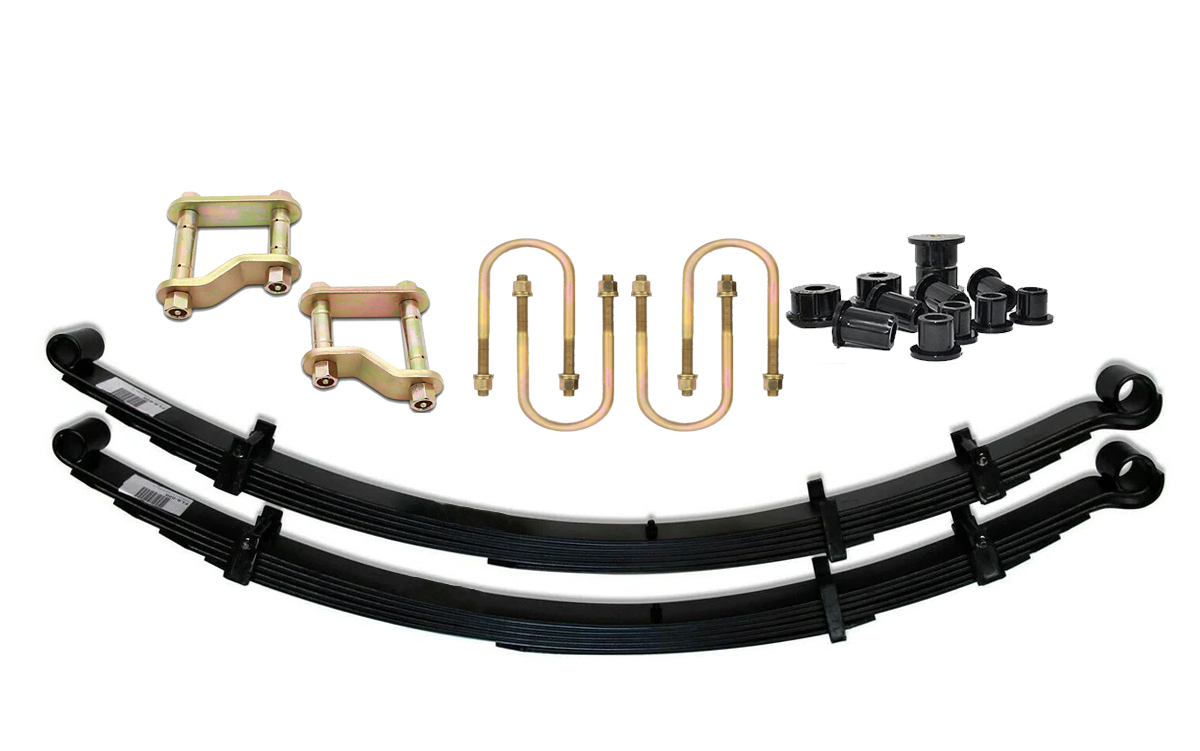
Dobinsons rear leaf spring pair for Toyota Hilux N80 with greasable shackles, U-bolts and polyurethane bushes

How should leaf springs look when they are healthy?

A healthy rear leaf pack has a visible curve, with the centre of the spring (where it clamps to the axle) sitting lower than the two eyes at each end. That curve is called the arch or camber, and it is what gives the spring its travel and its ride height. On most Australian dual-cab utes, the rear springs are designed to keep some positive arch even with a moderate load in the tray.

Beyond the arch, look for these signs of a spring in good condition:

  • Leaves stacked neatly and aligned. Each leaf should sit directly on top of the one below, with no leaf fanned out sideways.
  • Rebound clips in place. The metal clamps wrapped around the pack hold the leaves together on rebound. They should be tight and unbroken.
  • Centre bolt and U-bolts intact. The centre bolt locates the pack on the axle perch; the U-bolts clamp it there. Both should be tight, with no sign the axle has moved along the spring.
  • Bushes in good shape. The rubber or polyurethane bushes in the spring eyes and shackles should be firm, not cracked, split or squeezed out of the eye.
  • No cracks and no heavy rust between leaves. Light surface rust is normal on a working ute. Orange rust streaks bleeding out from between the leaves suggest the leaves are grinding against each other, which accelerates wear.

What are the signs of sagging or worn leaf springs?

Sagging springs usually show up as a change in how the vehicle sits and drives, long before anything looks broken. The most common symptoms are:

  • The rear sits lower than it used to, unladen. A nose-high, tail-down stance with nothing in the tray is the classic sign that the springs have lost arch.
  • One side sits lower than the other. A lean at the rear on level ground often points to one spring that has fatigued or cracked faster than its partner.
  • Bottoming out on bump stops. If the rear hits the stops over dips or corrugations with a load you have carried comfortably before, the springs have lost capacity.
  • Headlights aiming high when loaded or towing. The rear squats, the front lifts and your low beam dazzles oncoming traffic.
  • Clunks or knocks from the rear. Worn bushes, loose U-bolts or a broken leaf can all knock over bumps and during take-off.
  • The vehicle crabs or steers itself. A broken centre bolt or a shifted axle can let the rear axle sit out of square, which shows up as the ute tracking slightly sideways or a steering wheel that is off-centre on a straight road.

Shocks and springs work together, and some of these symptoms overlap with worn dampers. If the rear bounces repeatedly after a bump rather than sitting low, the shocks are the more likely culprit; our guide to the signs your 4WD shocks are worn covers how to tell them apart.

How do you check your leaf springs at home?

You do not need a hoist to get a good picture of spring health. Park on flat, level ground with the tray empty and fuel roughly where it normally is, then work through these checks:

  1. Measure guard height. Measure straight up from the centre of each wheel hub to the edge of the wheel arch, on all four corners. Write the numbers down. Compare left against right, and compare against any measurements you took when the vehicle was newer or after a previous suspension job. Taking a baseline now is useful even if everything looks fine.
  2. Look at the arch. Crouch level with the rear spring and look along it. You should see a clear curve with the eyes higher than the centre. A spring that looks flat, or curves the wrong way, has lost its set.
  3. Inspect each leaf. With a torch, follow each leaf from eye to eye. Cracks usually start near the centre bolt or near the eyes. Check that no leaf has slid sideways out of the stack.
  4. Check the hardware. Look at the U-bolts, centre bolt, rebound clips, shackles and bushes. Any missing clip, loose nut or bush hanging out of its eye needs attention.
  5. Repeat with your normal load. Load the ute the way you actually use it and measure again. A big drop at the rear under a load you carry every week tells you the springs are working near or beyond their comfortable range.

What causes leaf springs to sag?

Every leaf spring slowly loses some arch over its life; steel under repeated stress fatigues. What decides how quickly that happens is how hard the spring works. The biggest factors on Australian 4WDs are:

  • Constant load. Canopies, drawer systems, water tanks, fridges, dual batteries and rear bars all sit on the rear springs every day. A spring carrying a heavy constant load is always partly compressed and fatigues faster.
  • Towing ball weight. Tow ball download sits behind the rear axle, so it compresses the rear springs and lifts the front at the same time.
  • Overloading. Repeatedly carrying loads beyond the spring's design range can flatten a pack permanently and is a common cause of cracked leaves.
  • Corrugations and heat. Long stretches of rough road cycle the springs thousands of times per hour, especially when worn shocks let them move more than they should.
  • Corrosion. Rust between the leaves increases friction and creates stress points where cracks start.

Which fix suits your situation?

The right fix depends on why the springs sagged and how you use the vehicle. This table is a starting point, not a diagnosis; a suspension specialist should confirm the cause before you buy parts.

What you seeLikely causeUsual fix
Rear low unladen, both sides evenSprings fatigued with age and useReplace the pack as a pair, rated for your actual constant load
Rear only sags when towing or carrying a big occasional loadSprings are fine for daily use but load varies a lotAirbag helper kit to support the spring when loaded
Sits level empty but bottoms out with your everyday loadSpring rating too light for the permanent accessoriesHeavier-rated leaf pack matched to that constant load
One side lower than the otherOne spring fatigued or cracked, or uneven loadInspect for cracks; replace both springs as a pair
Clunks, rear axle off-square, or a leaf shifted sidewaysBroken leaf, broken centre bolt or loose U-boltsStop and inspect before further driving; replace damaged parts
Squeaks and knocks, arch still goodWorn bushes or dry shackle pinsReplace bushes; greasable shackles and pins make future servicing easier

Should you replace, re-arch or add airbags?

Replacing the pack is the most complete fix. A new pair of springs restores ride height and capacity, and it is a good time to replace U-bolts, bushes and shackles at the same job. Always replace leaf springs as a pair so both sides sit and work the same. Choose the rating for the load you carry most of the time, not the heaviest pack on the shelf: an over-rated spring on a lightly loaded ute rides harshly and can make the rear skip over bumps.

Re-setting (re-arching) is a service some spring works offer, where the leaves are re-formed to restore arch. It can bring a pack back to height, but it does not replace steel that has already fatigued or cracked, so it suits springs that are sagged but otherwise sound. Get it assessed by the spring shop and compare the quote against a new pack before deciding.

Airbag helper kits sit between the chassis and axle and support the spring when you add air. They are a strong choice when your load changes a lot, such as a ute that tows a van a few times a year, because you can run low pressure empty and more pressure loaded. They support worn springs but do not fix them, and they do not increase your legal payload; see our explainer on whether airbags increase GVM or payload.

Whichever way you go, remember that springs change how the vehicle carries weight, not how much it is legally allowed to carry. If you are regularly close to your vehicle's limits, read do you need a GVM upgrade before choosing parts.

What about extended shackles, removing leaves and parabolic springs?

Three shortcuts come up often when owners research sagging springs, and each has a catch.

Extended shackles lift the rear by lengthening the shackle rather than restoring the spring. They change the shackle angle, which alters how the spring moves and, at extreme angles, can let the shackle flip past centre. The national modification guide, VSB14, says extended or adjustable shackles must not be used to raise a vehicle with leaf spring suspension. Replacing worn shackles with new standard-length or greasable shackles is a normal service item and a different thing entirely. Check your state's rules in our lift kit legality guide.

Removing a leaf to soften the ride reduces the pack's load capacity and puts more stress on the leaves that remain. On a ute that carries or tows, it trades short-term comfort for faster sag and a higher risk of a cracked leaf. A correctly rated pack and good shocks are the better route to a comfortable ride.

Parabolic springs use fewer, tapered leaves that touch mainly at the ends and centre, which reduces friction between leaves and generally gives a more supple ride. Conventional multi-leaf packs have more leaves sharing the load. Both designs sag with fatigue over time, and the right choice comes down to your load and use. Our comparison of coil springs vs leaf springs explains how leaf suspension carries load compared with coils.

Replacement leaf springs for your ute

We stock heavy-duty rear leaf packs from Tough Dog and Dobinsons for most popular Australian utes and leaf-sprung LandCruisers and Patrols, with multiple load ratings so you can match the pack to your accessories. Popular examples include the Dobinsons rear leaf springs for Hilux N80, the Tough Dog rear leaf springs for LandCruiser 78 and 79 Series and the Tough Dog rear leaf springs for Navara NP300. Browse the full leaf spring range, or the airbag helper kits if your load varies. Not sure which rating suits your setup? Contact us with your vehicle, accessories and typical load and we will point you to the right pack.

Frequently Asked Questions

How long do leaf springs last?

There is no fixed lifespan. A spring on a lightly used ute can hold its height for many years, while one carrying a heavy canopy and towing regularly can sag much sooner. The practical approach is to measure ride height once a year or at major services and replace the springs when the vehicle no longer sits or carries the way it should.

Should leaf springs be replaced in pairs?

Yes. Replacing only one spring leaves the vehicle with a new spring on one side and a fatigued spring on the other, which usually shows up as a lean and uneven handling. Replace both sides together, ideally with new U-bolts and bushes at the same time.

Will new leaf springs lift my ute?

Often, yes. A new pack restores the height lost to sag, and many aftermarket packs are designed to sit higher than factory. That extra height counts towards your state's lift limits, so check the rules before choosing a lifted pack, and match the front suspension so the vehicle sits level.

Can I drive with a broken leaf spring?

It is not recommended. A broken main leaf or centre bolt can let the axle move out of position, which affects steering and braking stability. Drive gently to a workshop only if it is safe to do so, and have the pack replaced before carrying a load or towing again.

Related guides: Nissan Navara leaf spring upgrade guide | Toyota Hilux suspension problems

4WDSuspension logo
Address
8 Hammond rd, DANDENONG, VIC, 3175, AU
ABN 88 625 044 377
Need Help?
1300 120 020
sales@4wdsuspension.com.au
Working Hours
Mon-Fri 9:00am - 4:30pm
Connect With Us
  • Facebook
  • Twitter
  • Youtube
  • Instagram

Information

  • Information

  • About Us
  • Delivery & Shipping
  • Privacy Policy
  • Refund & Warranty
  • Contact Us
  • FAQ
  • Blog

Support

  • Support

  • My Account
  • Track Order
  • Resolution Centre

Subscribe to our newsletter

Enter your email address below to subscribe to our newsletter and keep up to date with discounts and special offers.

Secure Payment

  • Afterpay
  • Web Payments
  • Web Payments
  • zipMoney
  • American Express
  • MasterCard
  • PayPal Checkout
  • Visa

Copyright © 2026 4WDSuspension | ABN 88 625 044 377 | 8 Hammond Rd, Dandenong VIC 3175

Terms & Conditions

Welcome to our website. If you continue to browse and use this website, you are agreeing to comply with and be bound by the following terms and conditions of use, which together with our privacy policy govern 4WDSuspension’s relationship with you in relation to this website. If you disagree with any part of these terms and conditions, please do not use our website.

The term ‘4WDSuspension’ or ‘us’ or ‘we’ refers to the owner of the website whose registered office is 8 Hammond rd, DANDENONG, VIC, 3175, AU. Our ABN is 88625044377. The term ‘you’ refers to the user or viewer of our website.

The use of this website is subject to the following terms of use:

  • The content of the pages of this website is for your general information and use only. It is subject to change without notice.
  • Neither we nor any third parties provide any warranty or guarantee as to the accuracy, timeliness, performance, completeness or suitability of the information and materials found or offered on this website for any particular purpose. You acknowledge that such information and materials may contain inaccuracies or errors and we expressly exclude liability for any such inaccuracies or errors to the fullest extent permitted by law.
  • Your use of any information or materials on this website is entirely at your own risk, for which we shall not be liable. It shall be your own responsibility to ensure that any products, services or information available through this website meet your specific requirements.
  • This website contains material which is owned by or licensed to us. This material includes, but is not limited to, the design, layout, look, appearance and graphics. Reproduction is prohibited other than in accordance with the copyright notice, which forms part of these terms and conditions.
  • All trademarks reproduced in this website, which are not the property of, or licensed to the operator, are acknowledged on the website.
  • Unauthorised use of this website may give rise to a claim for damages and/or be a criminal offence.
  • From time to time, this website may also include links to other websites. These links are provided for your convenience to provide further information. They do not signify that we endorse the website(s). We have no responsibility for the content of the linked website(s).
  • Your use of this website and any dispute arising out of such use of the website is subject to the laws of Australia.

Privacy Policy

This privacy policy sets out how we uses and protects any information that you give us when you use this website.

We are committed to ensuring that your privacy is protected. Should we ask you to provide certain information by which you can be identified when using this website, then you can be assured that it will only be used in accordance with this privacy statement.

We may change this policy from time to time by updating this page. You should check this page from time to time to ensure that you are happy with any changes.

What we collect

We may collect the following information:

  • name and job title
  • contact information including email address
  • demographic information such as postcode, preferences and interests
  • other information relevant to customer surveys and/or offers

What we do with the information we gather

We require this information to understand your needs and provide you with a better service, and in particular for the following reasons:

  • Internal record keeping.
  • We may use the information to improve our products and services.
  • We may periodically send promotional emails about new products, special offers or other information which we think you may find interesting using the email address which you have provided.
  • From time to time, we may also use your information to contact you for market research purposes. We may contact you by email, phone, fax or mail. We may use the information to customise the website according to your interests.

Security

We are committed to ensuring that your information is secure. In order to prevent unauthorised access or disclosure, we have put in place suitable physical, electronic and managerial procedures to safeguard and secure the information we collect online.

How we use cookies

A cookie is a small file which asks permission to be placed on your computer's hard drive. Once you agree, the file is added and the cookie helps analyse web traffic or lets you know when you visit a particular site. Cookies allow web applications to respond to you as an individual. The web application can tailor its operations to your needs, likes and dislikes by gathering and remembering information about your preferences.

We use traffic log cookies to identify which pages are being used. This helps us analyse data about webpage traffic and improve our website in order to tailor it to customer needs. We only use this information for statistical analysis purposes and then the data is removed from the system.
Overall, cookies help us provide you with a better website by enabling us to monitor which pages you find useful and which you do not. A cookie in no way gives us access to your computer or any information about you, other than the data you choose to share with us.
You can choose to accept or decline cookies. Most web browsers automatically accept cookies, but you can usually modify your browser setting to decline cookies if you prefer. This may prevent you from taking full advantage of the website.

Links to other websites

Our website may contain links to other websites of interest. However, once you have used these links to leave our site, you should note that we do not have any control over that other website. Therefore, we cannot be responsible for the protection and privacy of any information which you provide whilst visiting such sites and such sites are not governed by this privacy statement. You should exercise caution and look at the privacy statement applicable to the website in question.

Controlling your personal information

You may choose to restrict the collection or use of your personal information in the following ways:

  • whenever you are asked to fill in a form on the website, look for the box that you can click to indicate that you do not want the information to be used by anybody for direct marketing purposes
  • if you have previously agreed to us using your personal information for direct marketing purposes, you may change your mind at any time by writing to or emailing us.

We will not sell, distribute or lease your personal information to third parties unless we have your permission or are required by law to do so. We may use your personal information to send you promotional information about third parties which we think you may find interesting if you tell us that you wish this to happen.

If you believe that any information we are holding on you is incorrect or incomplete, please write to or email us as soon as possible at the above address. We will promptly correct any information found to be incorrect.

Afterpay

Shop Now. Pay Later.
Always interest-free.

shop

Add your favourites to cart

laptop>
                    <p>Select Afterpay at checkout</p>
                </div>
                <div class= sign up

Log into or create your Afterpay account, with instant approval decision

payments

Your purchase will be split into 4 payments, payable every 2 weeks

All you need to apply is to have a debit or credit card, to be over 18 years of age, and to be a resident of country offering Afterpay

Late fees and additional eligibility criteria apply. The first payment may be due at the time of purchase
For complete terms visit afterpay.com/terms